On This Page ⌄
Cat ownership represents a major segment of the Western pet market. According to the American Pet Products Association (APPA) 2026 Cat Report, which reflects 2025 survey results, 53 million U.S. households (39% of U.S. homes) owned a cat—a 5% year-over-year increase, with households owning three or more cats up 45% since 2018. In the United Kingdom, UK Pet Food population statistics estimate roughly 13 million cats across 31% of households, including 41% in London.
Because cat litter is a repeat-purchase consumable, it can support recurring orders for pet brands, importers, and e-commerce sellers when product performance stays consistent. Yet launching a private-label line involves more than selecting a base material and printing a bag. This private label cat litter sourcing guide outlines what U.S. and UK buyers should evaluate across pure plant, plant-mixed, and plant-mineral formulas—alongside practical sample checks, moisture-barrier packaging, customs verification, and environmental claim compliance.
Why US and UK Buyers Evaluate Plant-Based Cat Litter
Traditional sodium bentonite clay remains widely used across retail channels because it clumps quickly and feels familiar to many cats. For e-commerce and specialty brands, however, clay often brings heavier parcel weights, higher dust complaints if screening is weak, and buyer interest in non-mined alternatives.
Plant-based substrates—particularly tofu (soybean fiber/okara) and cassava (tapioca root starch)—have gained broader placement across online channels and specialty pet retail in the U.S. and UK. Lighter bags can ease parcel fulfillment for subscription and marketplace sellers, while lower-dust pelletized or screened formats appeal to indoor and multi-cat households.
Even so, buyers who order plant-based formulas without structured sample evaluation can encounter avoidable issues, including fragile clumps, residue sticking to tray floors, inconsistent odor control, or damp bags after ocean shipping. Clarifying the formula category first helps narrow supplier discussions.
Comparing Pure Plant, Plant-Mixed, Plant-Mineral, and Bentonite Options
Each litter category involves trade-offs among clump firmness, tracking, weight, cost, and labeling scope. Defining your sales channel, target retail tier, and litter-box compatibility before requesting quotes keeps sampling focused.
Pure Plant-Based Cat Litter: Tofu and Cassava
Pure plant-based formulas rely entirely on agricultural plant fibers and starches rather than mined clay.
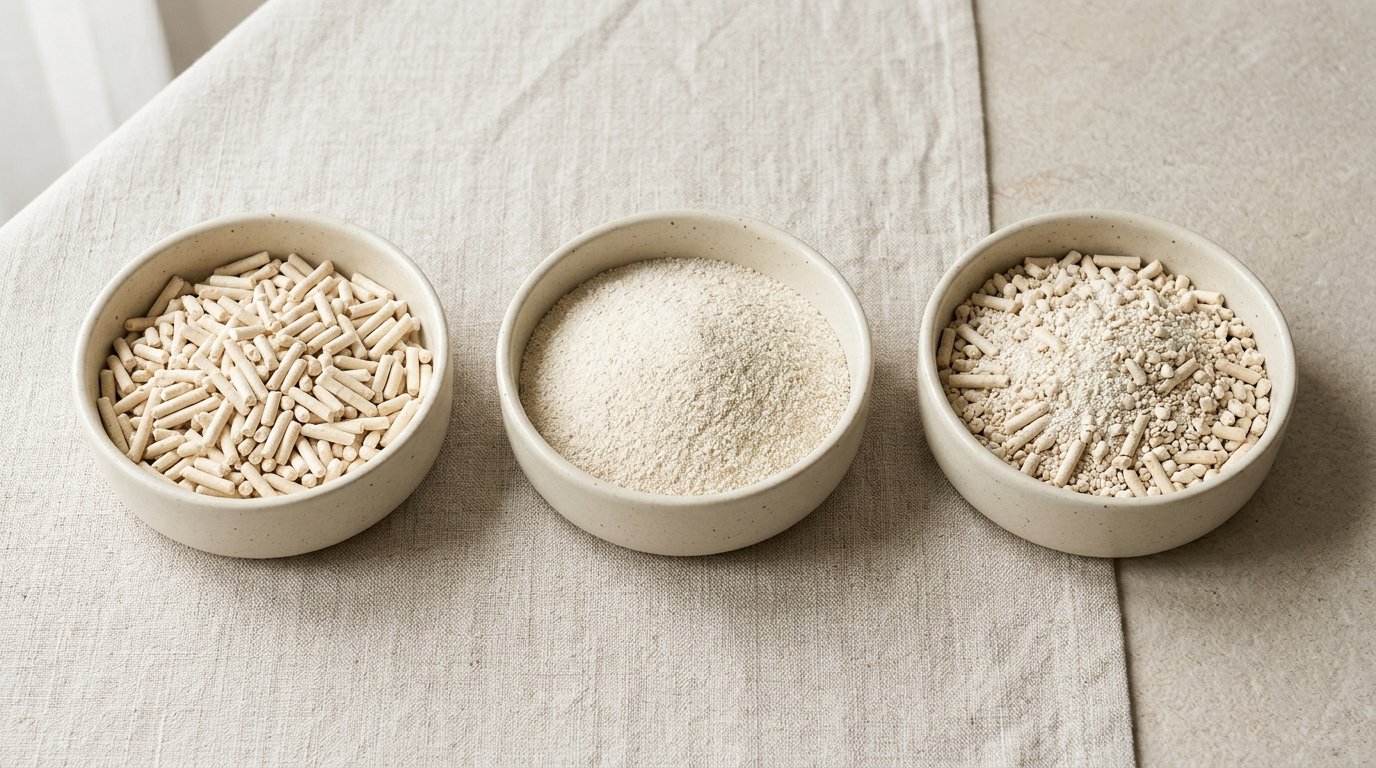
- Tofu cat litter (soybean fiber): Typically extruded into cylindrical pellets (commonly 1.5 mm to 2.0 mm in diameter) or crushed granules using soybean residue and food-grade starch binders. It is relatively lightweight, generally low-tracking in standard pellet form, and can keep dust low when properly screened. Trade-offs include softer clumps if the starch-to-fiber balance is weak, potential sticking on shallow tray floors, and sensitivity to humidity if bag seals fail.
- Cassava cat litter (tapioca starch): Produced from processed cassava root starch in fine, sand-like granules. It typically absorbs liquid quickly and forms firmer clumps than many pure tofu formulas, with a fine texture that may ease transition for cats used to clay. Trade-offs include higher raw-material cost than standard clay, greater paw tracking with finer particles, and potential stickiness if production moisture is poorly controlled.
Plant-Based Mixed Cat Litter (Tofu + Cassava)
Plant-based mixed formulas combine two plant substrates—commonly extruded tofu pellets with fine cassava granules (for example, 70/30 or 50/50 ratios)—while keeping the formula plant-derived.
- Strengths: Fine cassava granules fill spaces between tofu pellets, which can improve clumping speed, clump firmness, and resistance to tray-floor sticking compared with pure tofu alone.
- Trade-offs: Because pellets and fine granules differ in size and density, mixed bags can separate during transit if particle sizing and packing are not balanced.
Plant-and-Mineral Hybrid Cat Litter (Tofu + Bentonite)
Plant-and-mineral hybrids blend tofu pellets with a controlled share of sodium bentonite clay—sometimes alongside activated carbon or deodorizing granules.
- Strengths: Adding bentonite can strengthen clump cohesion and help manage unit cost while retaining a lighter feel than 100% clay.
- Trade-offs: Because the formula contains mined clay, it cannot be positioned or labeled as 100% plant-based, and disposal guidance must reflect its mineral content.
Natural Sodium Bentonite (Mineral Benchmark)
Even when developing a plant-focused range, some importers keep a low-dust bentonite SKU as a baseline option for price-sensitive wholesale accounts or automatic litter boxes designed around fine mineral granules. Buyers can review available formula directions on the Zhanzheng Pets Cat Litter OEM page.
Suggested Buyer Sample Comparison Checks Before Ordering
Supplier specification sheets rarely capture how a formula behaves in daily use. The checks below are practical, suggested buyer comparison tests for evaluating shortlisted supplier samples side by side—not standardized laboratory or industry certification methods.
- Clumping speed and drop check: Pour 50 ml to 60 ml of warm water onto a 6 cm litter bed, wait 60 seconds, scoop the clump, and drop it from about 30 cm onto a tray. Compare whether clumps stay intact or break into soiled crumbs across samples.
- Water absorption check: Using the same measured liquid volume, weigh or measure the size of the resulting clump. Lower litter consumption per dose generally indicates more efficient absorption and better cost-in-use for end customers.
- Bottom-tray sticking check: Pour liquid near the edge of a shallow 4 cm bed to replicate cats urinating against tray walls, then test whether the clump lifts cleanly without leaving wet starch paste behind.
- Odor-control check: Test both unscented and scented samples by applying a mild ammonia solution or running a controlled 24-to-48-hour trial in a covered test bin, checking whether odor is genuinely contained rather than briefly masked by heavy fragrance.
- Dust residue check: Pour 500 g of litter into a dark bin under side lighting and wipe the inner bag wall with a dark cloth to compare airborne fines and settled powder.
- Granule segregation check (mixed blends): Shake a sealed sample bag vigorously for two minutes to simulate transport vibration, then inspect whether heavier cassava or bentonite granules have settled to the bottom.
- Automatic litter box compatibility: If your customers use rotating self-cleaning boxes, verify that pellet diameter passes through sifter grates smoothly without jamming or discarding clean litter.
- Batch-to-batch consistency check: Where possible, compare samples from two separate production batches and retain a signed reference ("golden") sample so moisture content, granule sizing, odor, and clump firmness can be checked against bulk output.
Packaging Format, Moisture Control, and Container Economics
For plant-based cat litter, packaging acts as a moisture barrier as well as a retail display. Because tofu and cassava contain organic starches, prolonged exposure to humidity during extended ocean transit—depending on shipping route and season—can lead to caking, seal failure, or spoilage if barrier films are inadequate.
Vacuum-Sealed Bags vs. Stand-Up Pouches
- Vacuum-sealed bags (brick packs): Commonly used for 2.5 kg (about 5.5 lb) or 2.7 kg (about 6 lb) e-commerce SKUs. Removing air compacts bag volume, reduces pellet rubbing in transit, and improves carton density. However, hard pellets can cause pinholes and air leakage if film thickness or lamination strength is too low.
- Stand-up pouches with handles or zippers: Often chosen for brick-and-mortar pet stores and larger 4 kg to 6 kg formats where shelf visibility and resealability matter. Check barrier film structure and heat-seal strength, especially near die-cut handles.
- Bulk woven sacks and master cartons: Typical for wholesale distributors, shelters, or local repacking programs.
When modeling landed costs, note that plant-based litter is lighter by volume than clay, so shipping containers often reach their volume limit ("cube out") before hitting maximum payload weight. Reviewing bag dimensions, master cartons, and pallet layout alongside your OEM customization and packaging plan and a structured quality control and pre-shipment workflow can help optimize freight efficiency and reduce transit damage.
Import Compliance and Environmental Claims in the US and UK
Two operational areas regularly require advance preparation for U.S. and UK importers: customs classification for plant-derived materials and compliant sustainability wording on retail bags.
Customs and Plant-Health Verification
Because tofu and cassava litters are made from processed plant ingredients—and may contain corn starch, botanical additives, or scents—customs and agricultural authorities may review them differently from mined clay.
In the United States, shipments must be accurately declared through U.S. Customs and Border Protection (CBP) with a complete ingredient breakdown. Whether USDA APHIS agricultural entry checks or permits apply depends on the exact plant ingredients, level of processing (such as heat extrusion), country of origin, and tariff classification. Importers should confirm entry requirements with a licensed customs broker before booking freight.
In Great Britain, plant-health controls are overseen by Defra and the Animal and Plant Health Agency (APHA). Whether a phytosanitary certificate or pre-notification through the UK IPAFFS import pre-notification guidance applies likewise depends on the exact commodity code, ingredient composition, processing method, and country of origin. Request a full percentage composition sheet, a brief manufacturing/heat-processing summary, and the applicable Material Safety Data Sheet (MSDS/SDS) from your supplier before your broker files entry documents.
Environmental Claims Under US FTC and UK CMA Rules
Factory stock bags often print broad phrases such as "100% Biodegradable," "Eco-Friendly," or "Flushable." Carrying that wording onto U.S. or UK retail packaging without substantiation can expose brands to regulatory scrutiny or marketplace listing removals.
In the United States, the U.S. Federal Trade Commission (FTC) Green Guides advise against broad, unqualified environmental benefit claims and state that unqualified "biodegradable" claims require competent and reliable scientific evidence that the entire item will completely break down within a reasonably short period—typically one year—after customary disposal. Because household cat litter is usually sent to landfills where rapid breakdown does not occur, unqualified claims are difficult to substantiate.
In the United Kingdom, the UK Competition and Markets Authority (CMA) Green Claims Code requires environmental claims to be truthful, clear, unambiguous, complete across the product lifecycle, and backed by verifiable evidence, with compliance expectations extending across brands and retailers.
Regarding "flushable" claims, even when thin tofu pellets disperse in water, cassava-rich blends and plant-mineral hybrids can swell or settle in plumbing, and cat waste can carry parasites such as Toxoplasma gondii that wastewater treatment systems may not reliably remove. Many U.S. and UK brands avoid "flushable" wording altogether or add clear local-disposal guidance.
How to Prepare a Clear OEM Sourcing Brief
Suppliers can prepare more accurate quotes and sample matches when an initial inquiry specifies concrete commercial parameters:
- Target market and sales channel (U.S. marketplace fulfillment, UK pet retail, DTC subscription, or wholesale)
- Formula category (pure tofu, pure cassava, tofu-cassava mixed, tofu-bentonite hybrid, or bentonite) and particle size
- Scent and functional preferences (unscented, botanical scents, activated carbon, or odor-control additives)
- Bag format, net weight (showing accurate kg and lb equivalents for U.S. packaging), and artwork readiness
- Estimated trial order quantity and target delivery schedule
If you are also sourcing complementary hygiene items—such as litter boxes, mats, or scoops—reviewing the Pet Hygiene & Toilets product range alongside your litter brief can help keep category planning aligned. To discuss sample coordination, packaging formats, or private-label requirements, share your project outline through the Zhanzheng Pets contact page.